
Solar Energy in Lexington
Background
Lexington-Fayette Urban County Government (LFUCG) has a goal to reach net-zero carbon emissions by 2050, as outlined in the community's Comprehensive Plan, Imagine Lexington 2045. In part, the plan calls for Lexington to "Expand and Promote Energy Efficiency, Renewable Energy, and Electrification Initiatives."
In support of this goal, the LFUCG is working to be recognized as a SolSmart community - a designation of leading solar communities. This designation requires clear local policies, which Lexington adopted in September of 2025.
The Planning Commission and Urban County Council voted to allow for widespread use of solar technologies within the urban areas of Fayette County while not allowing for large-scale solar installations in the rural areas.
Following the recommendations of the Council Solar Working Group, further discussion of solar technologies in the agricultural areas is ongoing.
September 2025 Zoning Updates
Solar Technologies are now defined for local land use purposes; permitted types include:
- Rooftop and integrated solar energy systems in all zones.
- Small-scale ground-mounted (up to 2,500 sq. ft) in residential zones with a conditional use permit and allowed in business/industrial and agricultural zones as an accessory use.
- Intermediate-scale ground-mounted (up to 5 acres) in business zones, but would require a conditional use permit in agricultural zones.
- Large-scale solar (over 5 acres) in business/industrial zones.
Council voted to not allow for private, large-scale solar installations in the agricultural areas, but cannot prevent a utility company from seeking approval. Therefore, Council worked to include guidance for the Kentucky Public Service Commission should a utility company proposes such a project at the state level.
Local rules now specify that large-scale solar projects should:
- Never comprise more than 1% of the county’s total acreage
- Maintain at least 85% vegetative ground cover
- Include a land management plan
Council Solar Working Group
September 2025 through February of 2026, Council Members Liz Sheehan, Hil Boone, Tyler Morton, Dave Sevigny, and LFUCG staff met to learn more about and further discuss large-scale solar technologies on properties outside of the Urban Service Area (USA).
Recommendations of the working group include:
- Guidance on battery storage
- Strengthened decommissioning requirements
- Allow for large-scale solar on "brownfields"
- Require "dual agricultural use" for solar installations in agricultural areas
- Require a land management plan
- Require a water conservation plan
- Guidance on the creation of "Community Benefit Agreements"
Council voted to advance these recommendations to the Planning Commission for consideration. The Rural Land Management Board and Environmental Commission have also been asked to provide formal feedback.
July 2026 Planning Commission Recommendations
The Lexington Planning Commission considered proposals to, "address large-scale Solar Energy Systems (SES) in the agricultural zones, establish provisions relating to brownfield development, and create additional criteria for the review of Solar Energy Systems projects," during their July 9, 2026 meeting. The language submitted by the Urban County Council provided a pathway for large-scale solar energy systems to be installed in agricultural areas of Fayette County with a Conditional Use Permit, included exemptions for brownfield sites, and further clarified the guidance for community benefit agreements.
Division of Planning staff provided the Planning Commission with alternative language proposals that would not allow for intermediate or large-scale solar energy system installations in the agricultural areas. The staff alternative text also relaxed regulations around small scale solar installations in urban residential areas.
The Planning Commission voted 9-0 to approve the staff alternative text.
August 2026 Council Amendments
The Urban County Council voted during its August 18, 2026, Work Session to amend the proposed Zoning Ordinance Text Amendment language that was provided by the Planning Commission.
With a vote of 8-7, the Council reinstated the language to allow for intermediate and large scale solar with restrictions in the A-R and A-U zones for ground mounted solar, including a requirement to obtain a Conditional Use Permit, on up to 1% of the acreage in Fayette County. Council also changed the definition of 'footprint' for solar projects in agricultural zones to include, "any fencing or visual buffers and transmission infrastructure, except in the case of large-scale ground mounted solar energy systems, the footprint of which shall be calculated using the boundary line of the property on which a solar developer intends to install SES."
The ZOTA is currently scheduled to receive its first reading at the August 27, 2026, Council Meeting and to receive its second (final) reading at the September 10, 2026, Council meeting.
Helpful Terms & Definitions
The Planning Commission is the appointed body that oversees numerous "land use" issues in Lexington; it reviews development plans for proposed projects, makes recommendations to Council when there is a zone change request, helps to craft and approves Zoning Ordinance Text Amendments (ZOTAs), etc.
Lexington's Zoning Ordinance regulates how land in Fayette County is developed and used.
- A Conditional Use is an approved exception to the regular rules of the zone that a property is in; specific conditions must be met and requires special approval to address potential negative impacts.
- A Principle or Permitted Use is the primary use of land or a main building, which use is compatible with the purpose of and permitted in the zone it's located in.
- A Prohibited Use is any use of land which is not listed as permitted use or conditional use within a zone.
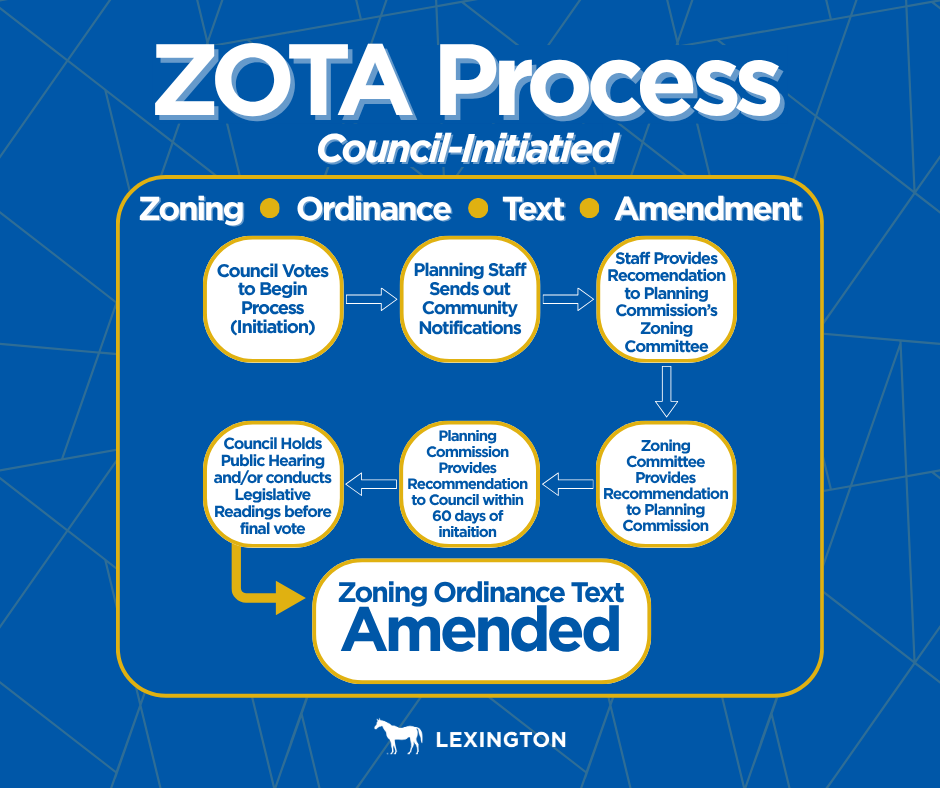
A Zoning Ordinance Text Amendment (ZOTA) provides a means for the Planning Commission, Urban County Council, or a public Applicant to update the Zoning Ordinance(External link). ZOTAs are not tied to a specific piece of property, but are based on the needs of the community as a whole.
Important / Upcoming Dates
May 20, 2026 -First meeting of Planning Commission Solar Work Group*June 9, 2026 -Second meeting of Planning Commission Solar Work Group*June 18, 2026 -Planning Commission Work SessionJuly 2, 2026 -Planning Commission Zoning CommitteeJuly 9, 2026 -Planning Commission Public Hearing on Solar ZOTA - 1:30 PM in Council Chambers (200 E. Main Street)August 18, 2026 -Council scheduled to review Planning Commission recommendations during Work Session - 3:00 PM in Council Chambers (200 E. Main Street)August 27, 2026 -Scheduled first reading of updated ZOTA - 6:00 PM in Council Chambers (200 E. Main Street)September 10, 2026-Scheduled second (final) reading of updated ZOTA - 6:00 PM in Council Chamber (200 E. Main Street)
*The Planning Commission formed its own "Solar Work Group" to review the recommendations sent from Council.
Council Wants to Hear from You!
Please complete the survey about the solar working group's recommendations below and join the online forum. Community feedback is made available to Council Members as they consider updates to the Zoning Ordinance.
Residents can also share their thoughts with the entire Council by email at: CouncilMembers-Email@LexingtonKY.gov.